
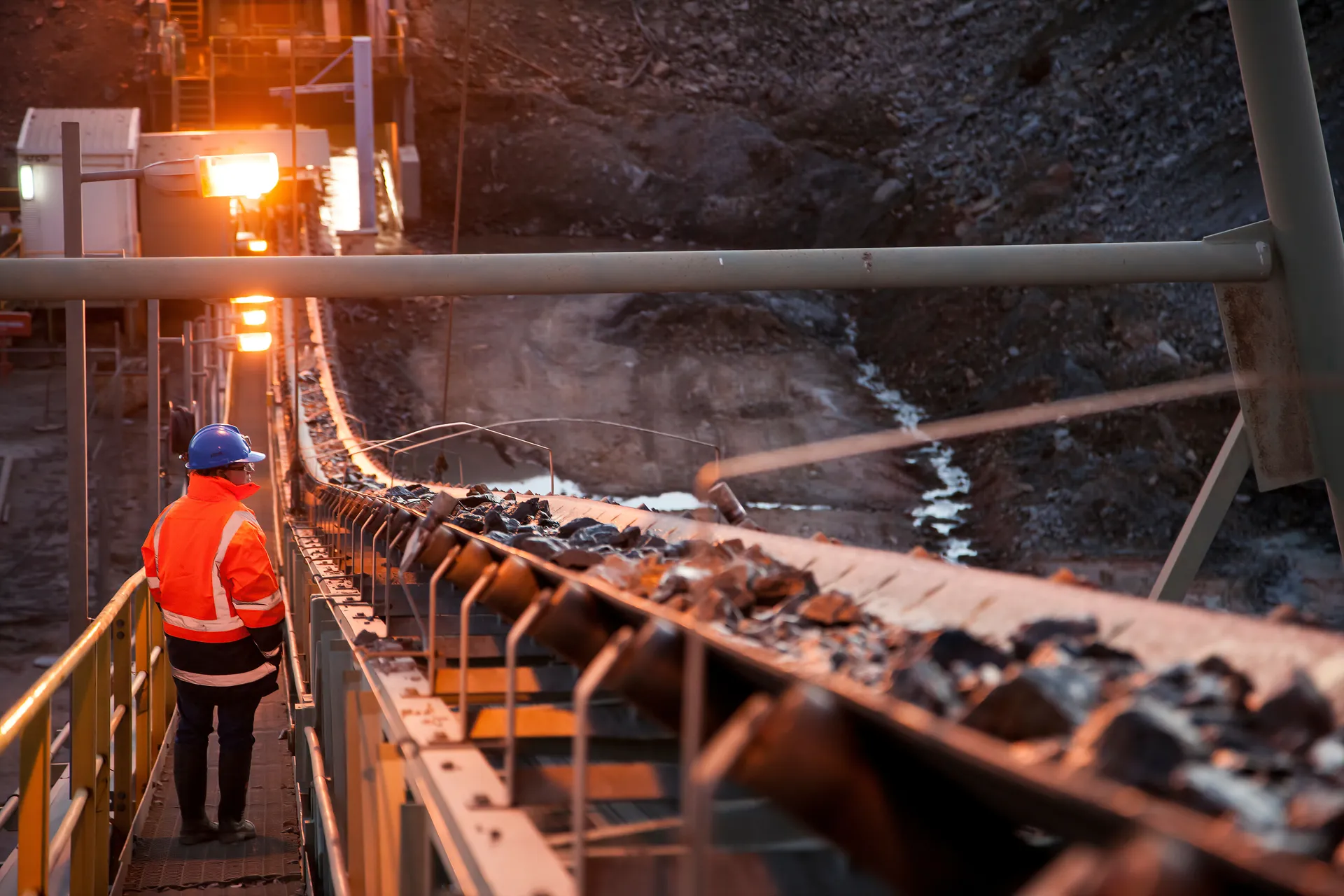
Mining conveyor carrying ore at dusk with plant lights in the background

Industry focus

Water treatment for mining: metals out, compliance in

Utility water to keep the plant running and effluent chemistry to keep the site compliant — including heavy metals removal with EPSE, from one accountable team.

Mining concentrates metals deliberately in the plant and accidentally in the water. Process water circuits, pollution control dams and discharge streams accumulate dissolved metals, and the water use licence puts hard numbers on what may leave the site.

Meanwhile the plant runs on water: cooling circuits, boilers, dust suppression and the process water treatment behind the make-up, all of which fail in the ordinary ways — scale, corrosion and fouling — just with bigger consequences. Our leadership has worked in and around South African mining and metallurgy for four decades, from extractive metallurgy on gold, coal, tin and uranium through mining process chemicals across gold, platinum and coal accounts.

The binding constraint

Heavy metals: the hardest number on site

For most mines the hardest water number is a metals limit in the WUL or DWS requirements — and conventional lime treatment takes out some metals and leaves others. Prosep is the appointed South African implementer and distributor of EPSE chemistry, which removes base, hazardous, radioactive and rare-earth metals from the fluctuating streams real mine water delivers. Metals removed from water are metals captured: treatment cost and resource recovery start to converge.

Effluent & heavy metals removal

Steel pipe coating plant

Problem
Acid pickling effluent, very low pH, high chlorides, dissolved iron, zinc and lead. Lime-only treatment left iron high, limited water reuse, generated heavy sludge, and forced a full plant clean every three months, draining 10 to 20 cubic metres each time.
Programme
EPSE chemistry verified at laboratory scale in Finland (November 2024) before full-scale implementation (June 2025). Daily on-site sampling run in parallel against lime-only treatment. pH control automated to a 9.5 target after operator variability was identified as a treatment quality risk.
Result
Iron consistently below 0.37 mg/L (previously above 0.87 mg/L). Lead and zinc removed where lime removed neither. Overall heavy metal reduction above 99.9%. Plant cleaning down from quarterly to once in eight months, that one precautionary. Fully recycled water, zero discharge. Sludge declassification from hazardous waste under review.

The full case is on our effluent treatment page.

Utility water

Keeping the plant itself running

The same accountability across the circuits that keep a mine in production.

01

Cooling water & HVAC

Mills, compressors, HVAC plant and process cooling circuits scale and corrode on harder, dirtier circuits than most — controlled with phosphonate and polymer chemistry dosed to a measured saturation index.

02

Boilers & steam

Where sites raise steam, our programmes cover feedwater, internal chemistry and blowdown control.

03

Settlers & process water

Settler and thickener performance is water chemistry as much as mechanics. Borehole and return-water make-up is treated to source; remote sites making their own potable water work to SANS 241.

The programmes

What a mining site runs on

Programmes, not products — priced transparently against scope, on the method set out in how we work.

Standards we work to

Programmes are designed against your water use licence and DWS discharge requirements, with written reporting that survives an audit. The engagement is the one on how we work: assess the circuit and the licence conditions, design with stated targets, implement, then monitor.

  • DWS discharge requirements
  • Water Use Licence conditions
  • SANS 241 — remote potable

FAQ

Mining water treatment questions

Can you treat mine water to meet WUL discharge limits on metals?

That is the core application of the EPSE chemistry Prosep implements: removal of base metals, hazardous metals, radioactive elements and rare earths from difficult, fluctuating streams, proven in a South African industrial application at above 99.9% overall heavy metal reduction. Each stream is verified by treatability work before full-scale implementation.

What is EPSE and whose technology is it?

EPSE is a heavy metals removal chemistry developed in Finland. Prosep is its appointed South African implementer and distributor: treatability verification through the EPSE laboratory, then full-scale dosing, integration and monitoring on site.

Do you handle the utility side, cooling and boilers, as well as effluent?

Yes, and that range matters operationally. When something unexpected happens in one water system, understanding how it connects to the rest of the plant is what allows fast diagnosis. Prosep covers boiler, cooling, process and effluent treatment as one accountable supplier.

Can treated mine water be reused on site?

Where treatment reaches the required quality, yes, and reuse is often the better economics. We have converted an industrial client to fully recycled water with zero discharge, and we design reuse against the site water balance.

A stream, a licence condition, or a metals problem?

Tell us which one. We assess the water circuit and the licence conditions, design a programme with stated targets, and report against them in a form that survives an audit.