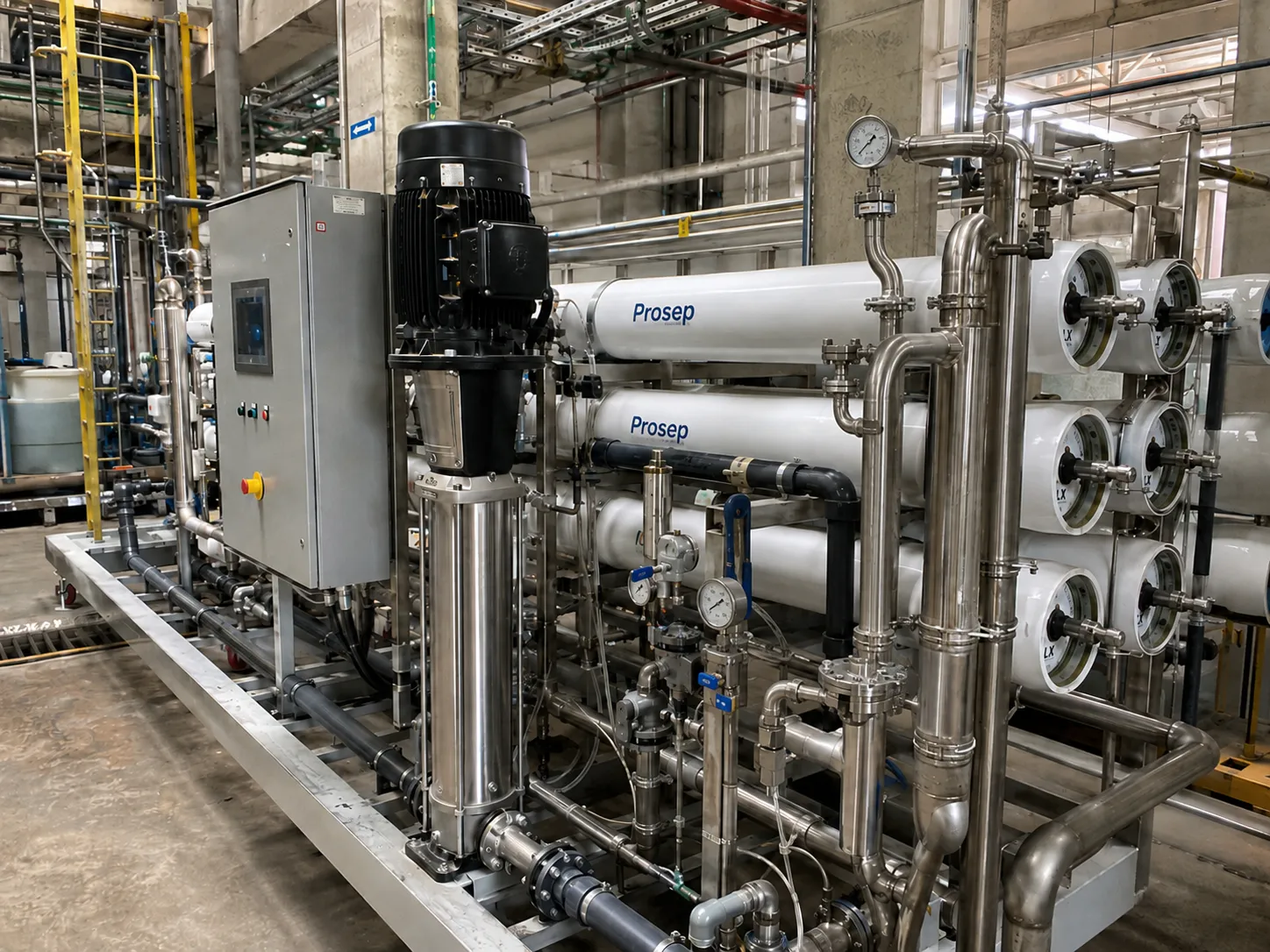
Skid-mounted reverse osmosis plant with membrane housings in a production facility

Process & production yield

Reverse osmosis plants: designed, supplied and kept alive on your site

Skid-mounted, containerised or built into your plant room — RO systems engineered for your feedwater, commissioned to a stated product quality, and run with the pre-treatment and chemistry that make the membranes last. Across South Africa, from Boksburg.

A reverse osmosis plant pushes water through a semi-permeable membrane under pressure. The membrane is a barrier to dissolved salts, inorganic molecules, organics, pyrogens, sub-micron colloids, viruses and bacteria; water molecules pass through freely and come out the other side as a purified product stream. It is the finest level of filtration available — removing around 98–99.5% of total dissolved solids — which is why RO is the answer wherever a process needs water that filtration and softening alone cannot deliver.

Prosep designs, supplies and commissions reverse osmosis plants for South African industry, and — the part that decides whether the plant is still running in five years — keeps them alive with the pre-treatment, antiscalant and membrane care they need. Bottling and food plants, boiler feedwater, pharmaceutical and chemical process water, mining, power generation and municipal supply: the duty changes, the discipline does not.

The programme

What a Prosep reverse osmosis plant comes with

The membranes are the smallest part of the job. Pre-treatment, chemistry, commissioning and monitoring are what decide whether the plant pays back.

01

Design & supply

RO systems sized to the duty and the feedwater analysis — skid-mounted plants of a few kilolitres an hour through to larger industrial trains — supplied containerised, skid-mounted or installed in your own building.

02

Pre-treatment

Media filtration, softening or ultrafiltration ahead of the membranes, selected for what the feedwater actually carries. An RO plant without correct pre-treatment is a membrane-replacement subscription.

03

Antiscalant & membrane care

Antiscalant matched to the feedwater analysis, clean-in-place chemicals for periodic cleaning, and a biocide regime where biofouling is the risk — the chemistry that keeps a plant alive.

04

Commissioning & monitoring

Commissioned against a stated product quality and recovery, then monitored: membrane performance normalised and reported, so a fouling trend is caught as chemistry before it becomes capital.

Reverse osmosis plant at a glance

Prosep reverse osmosis plant specification at a glance
SpecificationTypical
CapacitySkid-mounted plants of a few kilolitres an hour, through to larger industrial trains, sized to the product flow and the recovery the feedwater allows
FormatContainerised, skid-mounted, or installed in your own building; plants can be installed throughout Africa
Dissolved salt rejectionTypically 95% to more than 99%
Total dissolved solids removedAround 98–99.5%
Bacteria removedAround 99%
Pre-treatmentMedia filtration, softening or ultrafiltration, selected for what the feedwater carries
Membrane careAntiscalant matched to the feedwater analysis, clean-in-place chemicals, and a biocide regime where biofouling is the risk

RO or softening?

Softening removes hardness. Reverse osmosis removes the salts.

An ion-exchange softener swaps calcium and magnesium for sodium — the water stops scaling but its dissolved solids do not fall. When the process needs low-conductivity water, when a boiler runs at pressure, when a borehole source is saline, or when purity itself is the specification, softening runs out of road and RO takes over. The two are not rivals: on most plants the softener is the pre-treatment that protects the membranes. We state which your site needs from the water analysis, before you commit.

Proof

Operational for over five years

A 4.5 m³/h reverse osmosis plant on borehole feed that turned a food producer's municipal supply into the backup.

Process water — reverse osmosis

Food producer, Cosmo City

Problem
Rising municipal water consumption costs.
Programme
A 4.5 m³/h reverse osmosis system on borehole feed, engineered and installed by Prosep, commissioned October 2020.
Result
Operational for over five years. Municipal water cut to a backup role used mainly during planned Rand Water shutdowns. In a reference month, around 1,140 kl of treated water produced against 239 kl of municipal top-up.

Where RO fits

One stage in a full water programme

An RO plant feeds a boiler, a bottling line, a potable supply or a process — and sits inside the site's water balance.

Standards we work to

Where RO permeate becomes drinking water, the programme is designed against SANS 241. The reject stream is part of the design from day one: where it reaches a discharge point, DWS requirements apply, and where the water balance allows, it is recovered rather than lost. The whole plant is engineered as one water balance with our process water treatment capability, and run on our own range of water treatment chemicals, supplied with the dosing and monitoring that make them hold.

The original Prosep reverse osmosis brochure is free to download from our brochures and downloads page.

For a side-by-side comparison, see reverse osmosis vs softening vs filtration.

FAQ

Reverse osmosis plant questions

What does a reverse osmosis plant remove?

Reverse osmosis is the finest level of filtration available. A semi-permeable membrane acts as a barrier to dissolved salts, inorganic molecules and organic molecules with a molecular weight above roughly 100, while water passes through to form a purified product stream. Rejection of dissolved salts is typically 95% to more than 99%, and RO removes around 98–99.5% of total dissolved solids and 99% of bacteria.

When do we need reverse osmosis rather than a softener?

A softener exchanges hardness — calcium and magnesium — for sodium; it does not reduce the total dissolved solids. When the process needs low-conductivity or low-TDS water, such as high-pressure boiler feed, pharmaceutical or bottling duty, or a borehole source with high salinity, softening alone cannot get there and RO is the right tool. Often the answer is both: a softener as pre-treatment protecting the membranes.

What size reverse osmosis plant do we need?

That comes out of the water balance, not a brochure band: the product flow the process needs, the recovery the feedwater allows, and the hours the plant will run. Prosep has supplied skid-mounted plants of a few kilolitres an hour through to larger industrial trains — including a 4.5 m³/h plant on borehole feed for a Cosmo City food producer, running since October 2020.

How long do the membranes last?

That depends almost entirely on pre-treatment and chemical care. With correct pre-treatment, a matched antiscalant programme and normalised, monitored performance data, membranes reach their design life. Without those, replacement becomes a recurring cost. Prosep programmes exist to keep plants on the first path.

Can Prosep take over an RO plant we already own?

Yes. We assess the existing plant and its feedwater, put a pre-treatment, chemical and monitoring programme around it, and take accountability for its performance going forward.

Send us your water analysis.

Tell us the product quality and flow your process needs and what your source water looks like. We will state the plant, the pre-treatment, the chemistry and the cost — against the municipal alternative — before you commit.