
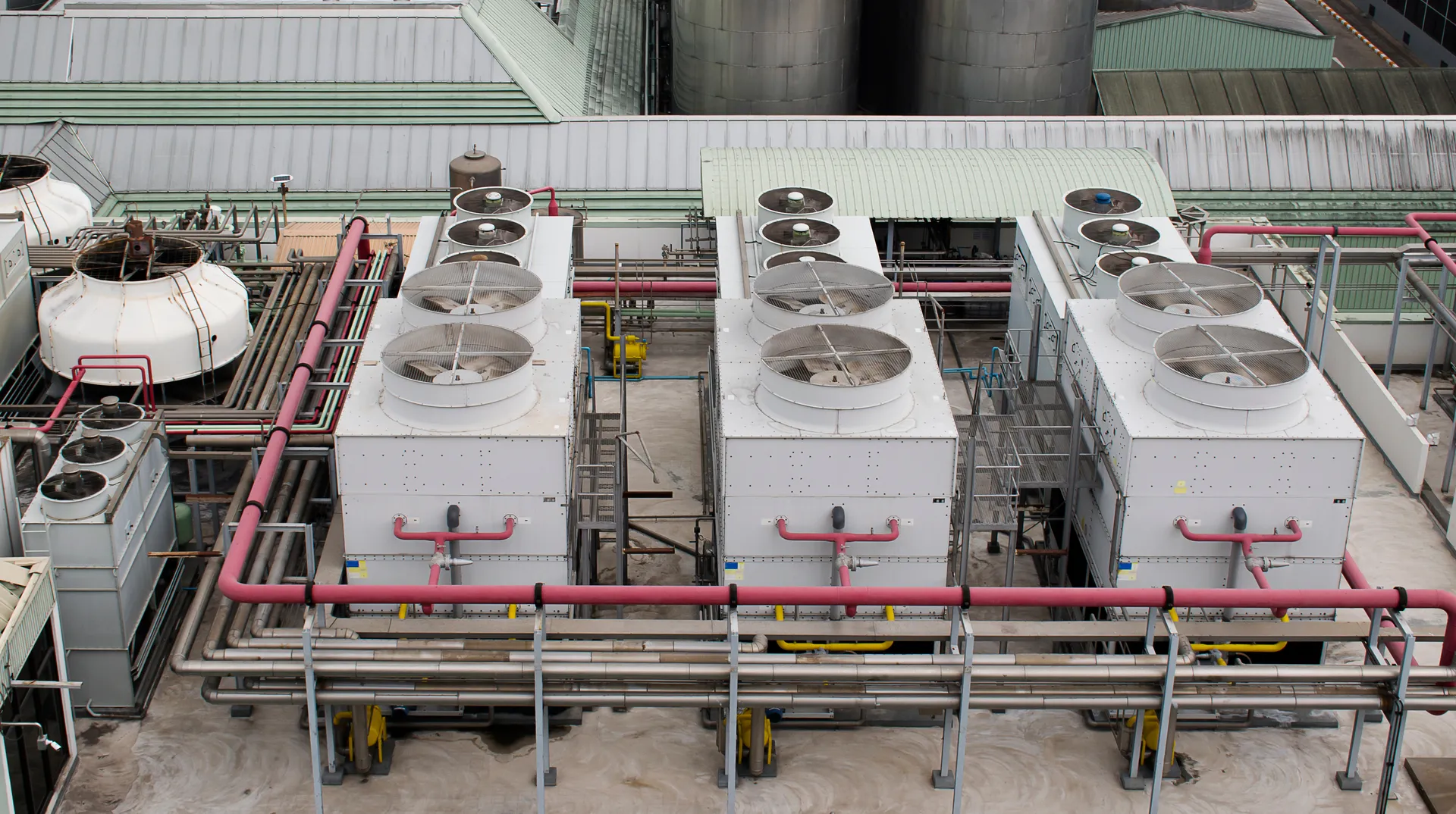
Aerial view of industrial cooling towers

Asset reliability

Cooling water treatment that holds the line on scale, corrosion and Legionella

Scale, corrosion and microbiological control are the same water and the same programme. We dose to a saturation index we measure on site, with Legionella management to SANS 893 principles.

A cooling system fails three ways: it scales, it corrodes, or it grows things. Usually it does all three at once, because the conditions that suppress one problem feed another. Run it too concentrated and calcium carbonate comes out of solution on your hottest, most expensive surfaces. Run it too lean and you pay for water and chemicals you do not need.

Prosep runs cooling water as a controlled chemical system. We control calcium carbonate and silica scaling in high-cycle systems with targeted phosphonate and polymer programmes, dosed to a saturation index we monitor on site. Corrosion and microbiological control are designed into the same programme, because they are the same water.

The programme

What a Prosep cooling programme covers

Scale, corrosion and microbiological control — engineered together, because they are the same water.

01

Scale control

Phosphonate and polymer chemistry selected for your water, cycles and skin temperatures, dosed against a saturation index we measure rather than assume — maximum cycles, minimum water and blowdown, without crossing the line where scale wins.

02

Corrosion control

Inhibitor programmes matched to the metallurgy in the circuit, monitored with the corrosion measurement methods the site can sustain, and verified in the water analysis on every visit.

03

Microbiological & Legionella

Oxidising and non-oxidising biocides designed around system half-life and demand, with dip-slide and plate-count monitoring, and Legionella risk management built on the principles of SANS 893.

04

Water efficiency

Cooling towers are most plants' biggest evaporative water users. Pushing cycles of concentration safely upward is the cheapest water saving most sites have — and it is a chemistry problem.

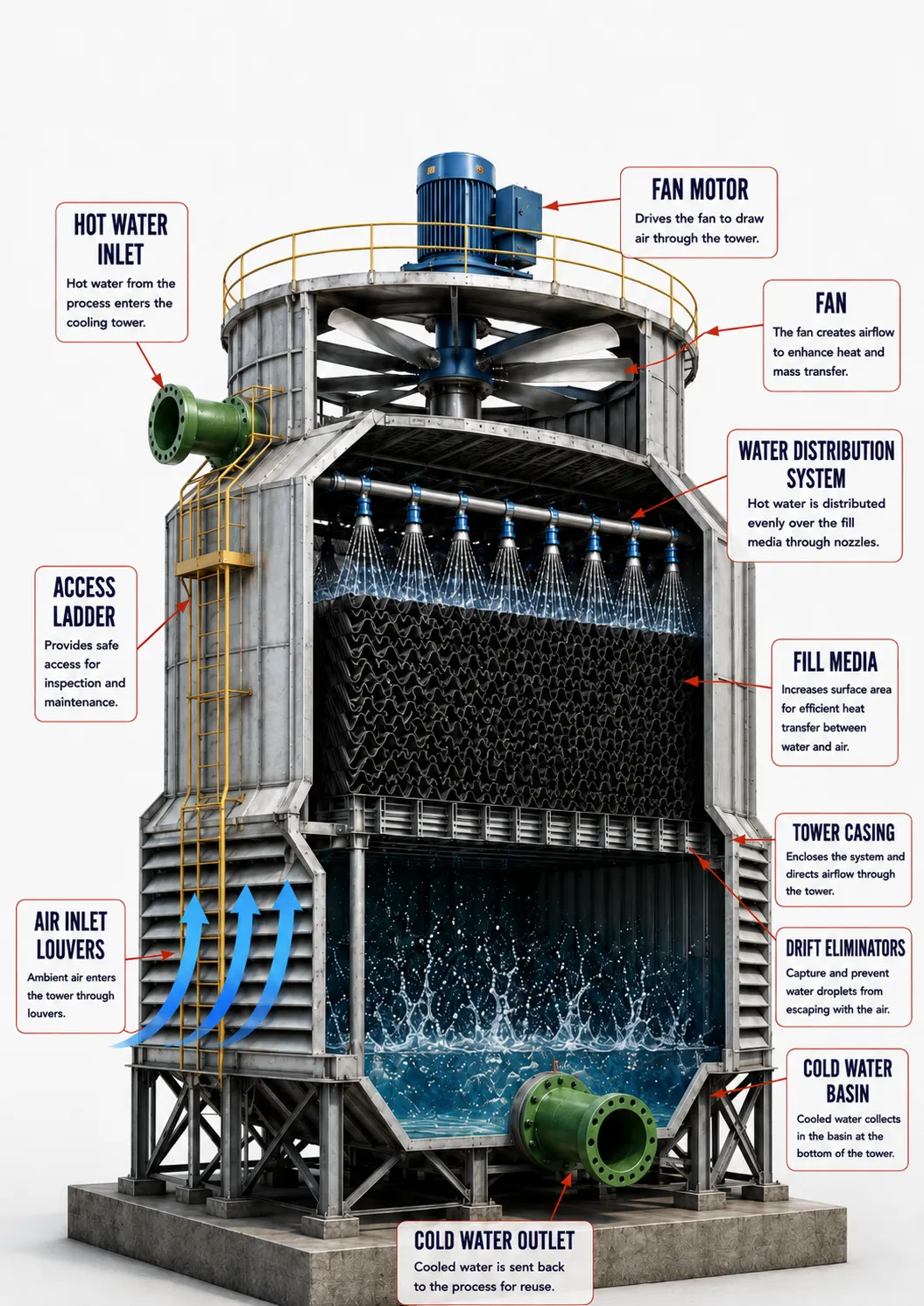
Cutaway of an induced-draft cooling tower showing the fan, water distribution system, fill media, drift eliminators and cold water basin

The whole circuit

We treat the system, not the tower basin

Scale on the fill, biofilm on the exchangers, corrosion in the pipework — they are one connected circuit. The programme starts with a site assessment (water analysis, system survey, metallurgy, current regime and failure history), then targets you can hold us to: a saturation-index range, corrosion expectations and microbiological limits.

Then implementation, dosing equipment included, on the routine described on how we work. Where the circuit is fed from a borehole, a river or a reuse stream, the pretreatment is handled by our process water treatment team as part of the same programme — which ties straight into the compliance and sustainability outcomes we engineer for. Closed recirculating loops on the same site need their own chemistry — see closed-loop and cooling tower management.

Proof

When cooling water attacks production, not just the tower

Cooling water touches everything it cools. A circuit nobody was treating was corroding the product itself.

Cooling water chemistry

Plastics moulding plant, Pretoria

Problem
Corrosion through a roughly 2 m³/h cooling water circuit damaging production moulds, which were going out for polishing at around R3,000 each.
Programme
A cooling water chemistry programme designed for the circuit and the mould metallurgy.
Result
System fully operational; corrosion problem resolved.

Who this is for

Every sector that rejects heat

From a few hundred kilolitres to multi-megalitre circuits — power, food and beverage, mining, plastics and general manufacturing.

Standards we work to

Legionella risk management is built on the principles of SANS 893 — risk assessment, monitoring and control — so your evidence stands up when an auditor, an insurer or the Department of Employment and Labour asks for it under the OHS Act.

  • SANS 893 — Legionella control
  • OHS Act

FAQ

Cooling water treatment questions

How do I control Legionella in a cooling tower in Gauteng?

Through a managed programme, not a once-off dose: a risk assessment of the system, an oxidising biocide regime designed for the system's volume and demand, routine microbiological monitoring including periodic Legionella testing, and documented records. Prosep designs and runs these programmes working to the principles of SANS 893 and the OHS Act.

What chemicals are used in cooling water treatment?

Typically phosphonate and polymer scale inhibitors, corrosion inhibitors matched to the circuit metallurgy, and oxidising biocides supported by non-oxidising biocides where needed. The specific chemistry follows the water analysis and the system, which is why Prosep sells engineered programmes rather than catalogue products.

How many cycles of concentration should my cooling tower run?

As many as the chemistry can safely hold, because every additional cycle cuts make-up water and blowdown. The limit is set by your water's scaling species, mainly calcium carbonate and silica, and by the inhibitor programme. Prosep doses to a measured saturation index, so cycles are pushed by data rather than by guesswork.

Can poor cooling water chemistry damage production equipment, not just the tower?

Yes. Cooling water touches everything it cools. We resolved exactly this for a Pretoria plastics moulding plant where untreated cooling water was corroding the moulds themselves, with each affected mould costing around R3,000 to polish. The treatment boundary is the whole circuit, not the tower basin.

How often will Prosep be on site?

Visit frequency is set in the programme against system criticality, typically with operator tests between visits. On every visit our engineers sample, test against the programme targets, adjust dosing, and report in writing.

Worried about a tower or a circuit?

Send us a water analysis and tell us what is failing. We will assess the system, set saturation, corrosion and microbiological targets, and run the programme to them.